- Published on
Combinatorial Purged Cross-Validation
Financial observations often overlap in time. A position opened today may depend on prices observed several days later, so a random split can allow the training sample to contain information connected to the test sample. Combinatorial purged cross-validation builds several train and test arrangements, then removes observations whose information intervals overlap.
The central construction
Suppose the ordered sample is divided into groups and each test set contains groups. The number of distinct train and test combinations is
Here, is the number of ordered groups, is the number selected for testing, and denotes the factorial. The construction produces
complete test paths when the combinations are arranged so that every group appears equally often. The symbol is the number of paths, not a performance score.
A compact view of three validation paths. Actual purging is determined by observation intervals, not merely by the visible distance between groups.
Purging and the embargo
Purging removes a training observation when its information interval intersects a test interval. An embargo adds a short exclusion period after a test group. These two operations address different forms of temporal connection: direct interval overlap and unusually close observations near a test boundary.
| Step | What changes | Purpose |
|---|---|---|
| Grouping | Ordered observations are placed into groups | Preserve time order |
| Combination | groups form each test set | Create varied test conditions |
| Purging | Overlapping training observations are removed | Reduce direct information overlap |
| Embargo | Nearby observations after a test group are excluded | Reduce boundary dependence |
| Path assembly | Test predictions are joined in time order | Compare several complete histories |
This procedure supplies a distribution of validation outcomes. It does not guarantee future profitability, remove every source of dependence, or repair a poorly stated prediction problem.
Validation paths after purging and embargo
The notebooks show both the construction of the splits and the results obtained from them. The first figure shows six of the fifteen train and test combinations used in the example.
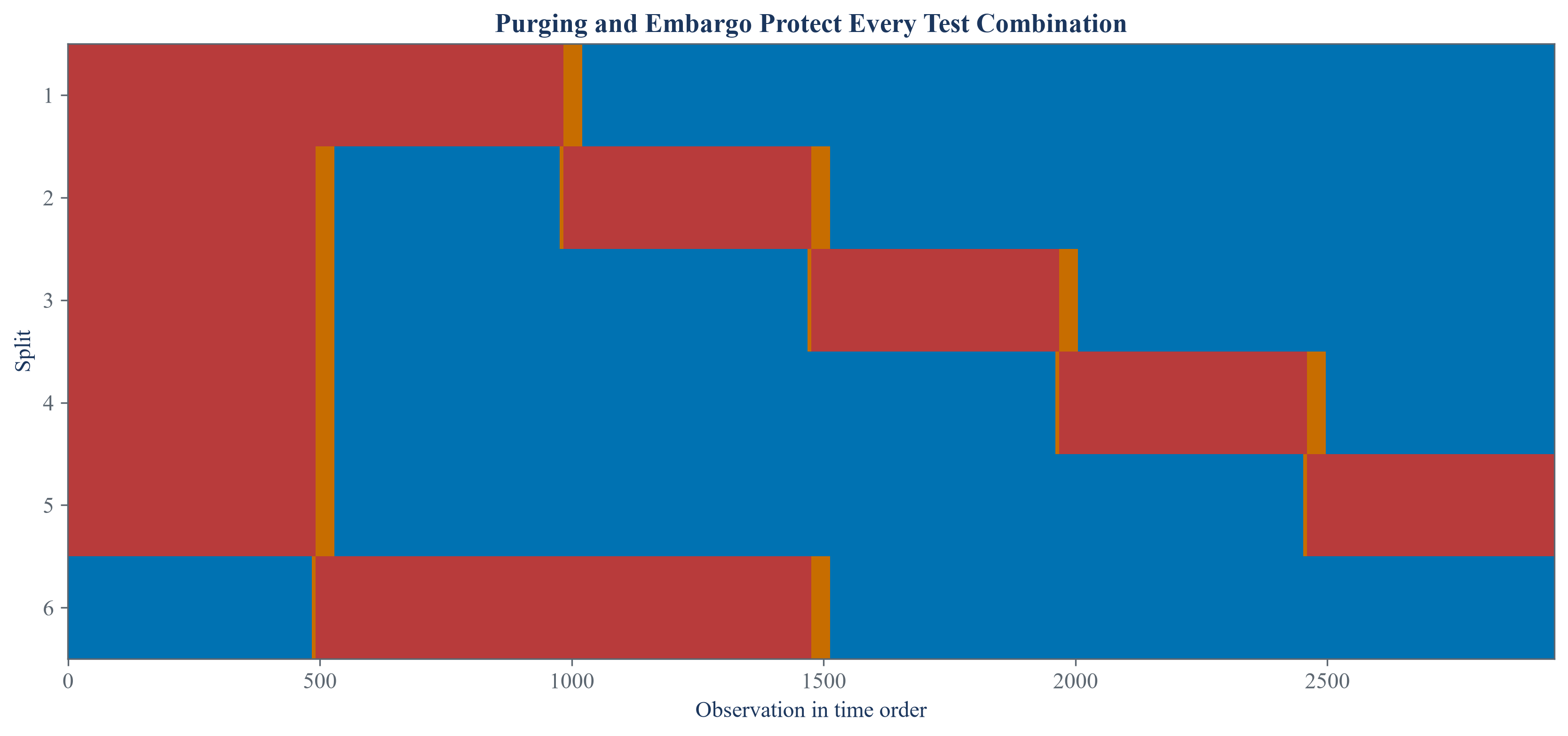
Blue observations are used for training, red observations for testing, and the narrow orange intervals are removed by purging or the embargo. The removals change with the location of each test set.
The next figure uses public BTC/USDT observations. It compares path accuracy for the standard, bagged, and adaptive versions of the procedure.
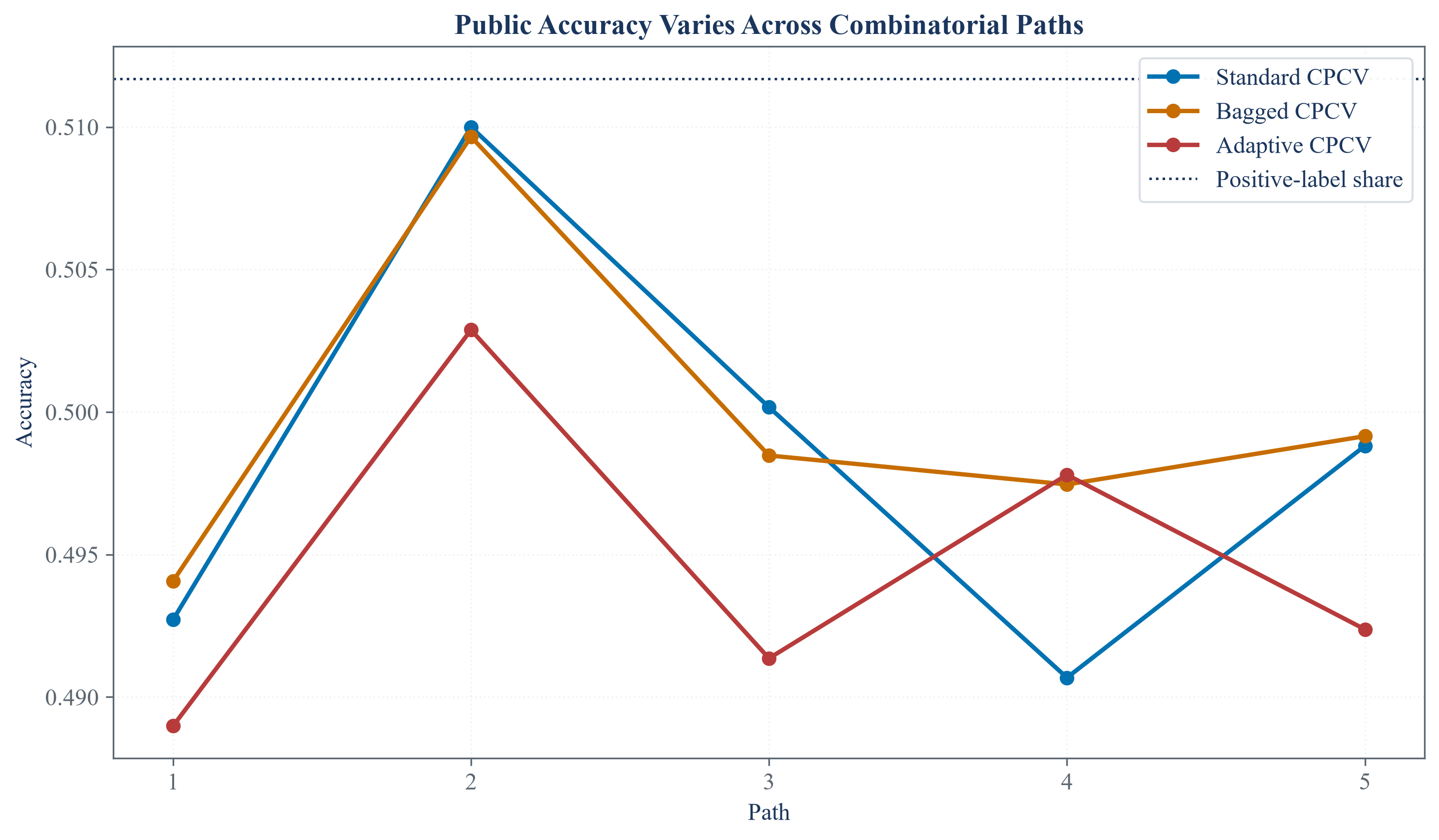
Accuracy changes across the five paths, while all three methods remain close to one half. The example illustrates why the variation across paths matters; it is not evidence of future trading performance.
Reading the results
The examples use RiskLabAI 3.2.0 to construct the splits. Each notebook shows the exclusions and path diagnostics directly, making it possible to compare the full set of validation paths instead of relying on one summary score.
Notebooks
All three notebooks are public and have passed full execution checks.
| 1. Enumerate valid group combinations — Split and path counts |
| 2. Remove temporal overlap and assemble paths — Path-level diagnostics |
| 3. Compare validation paths with a public data example — Figures and summary tables |