- Published on
The Factor Mirage
A factor can predict returns for reasons that do not survive intervention. These notebooks trace two common sources of that gap: an omitted common cause and selection on a variable influenced by both the factor and the outcome.
The central relation
In a simple omitted-common-cause model,
is the measured factor, is the outcome, and is an omitted common cause. The disturbances are and . The true effect of is , while is the coefficient obtained after omitting . The terms and measure how strongly enters the factor and outcome equations.
Why precise estimates can miss the causal effect
The first experiment compares the true factor effect with the coefficient produced after omitting a common cause. The repeated-specification result shows that more observations can make a misleading coefficient more precise rather than more causal.
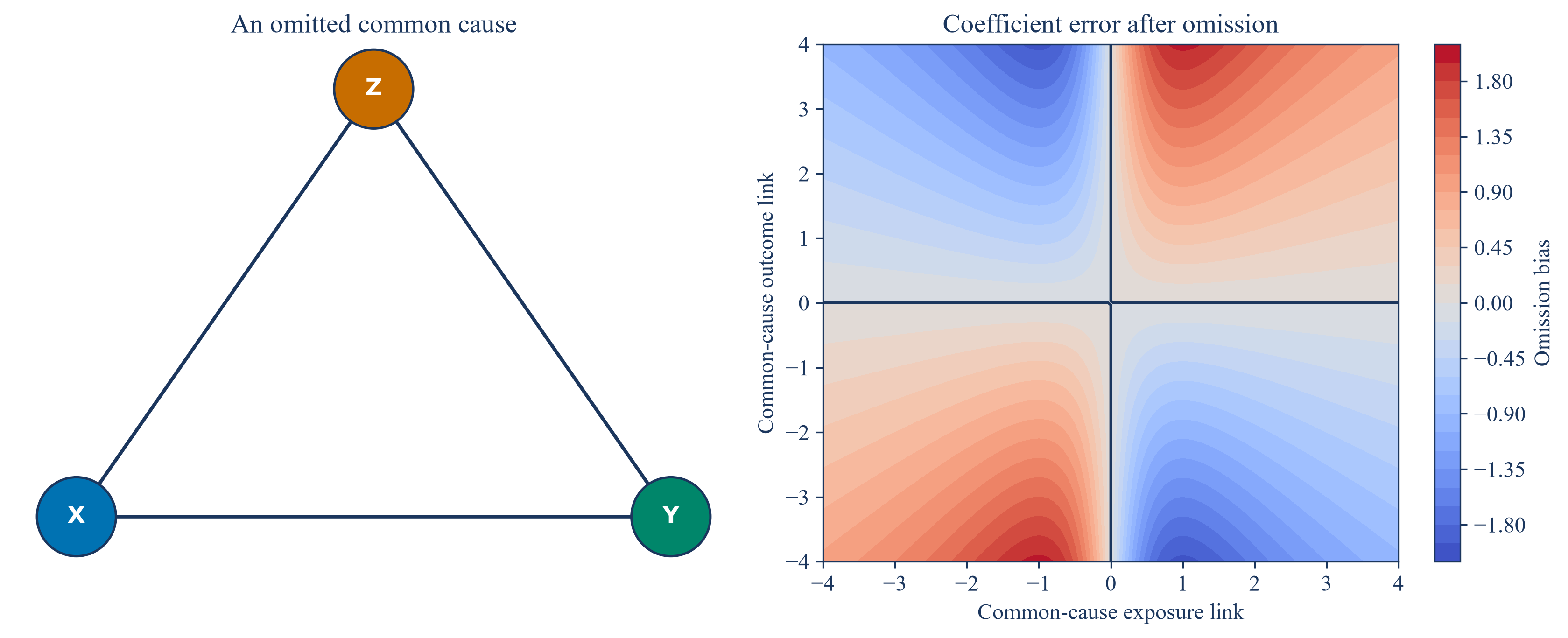
The common cause creates an additional path between the factor and outcome. Omitting it adds the path contribution to the measured factor coefficient.
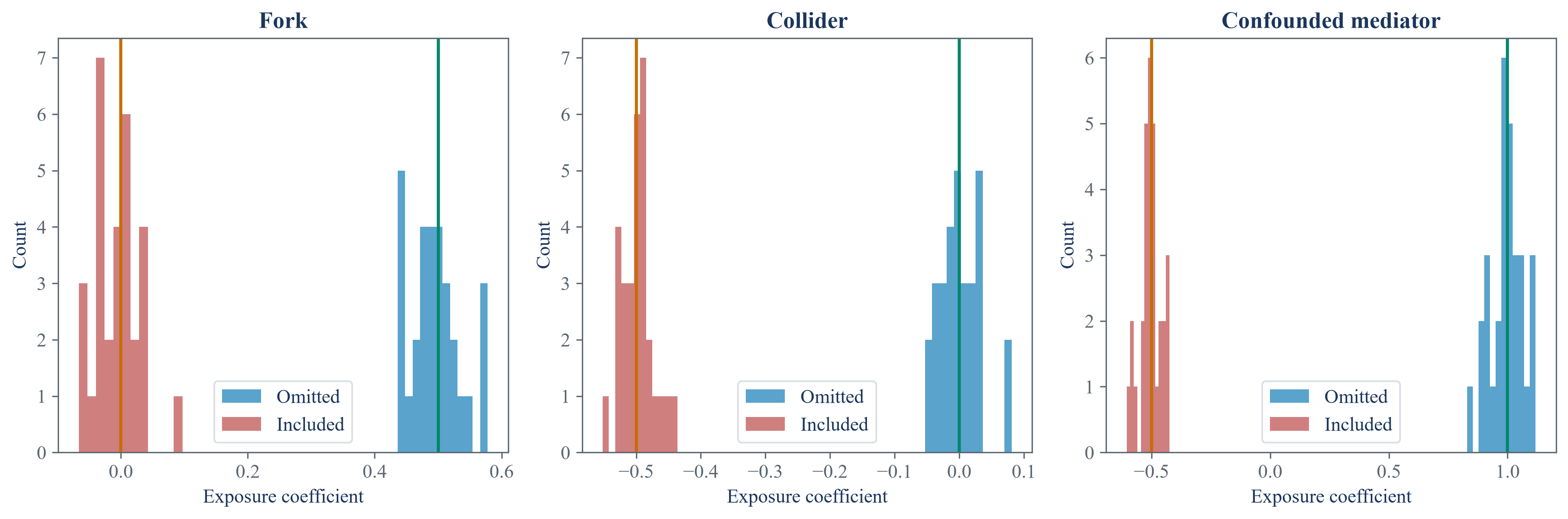
Repeated samples separate random variation from specification error. A stable distribution around the wrong target is still evidence of misspecification.
Large samples reduce sampling noise, but they do not repair a missing causal variable or selection created by the study design.
Notebooks
| 1. How omitted confounding distorts performance |
| 2. How unnecessary conditioning creates bias |
| 3. Diagnosing misspecification in the population |