- Published on
Fractional Differentiation
Ordinary differencing can remove both persistence and useful long-run information. Fractional differentiation introduces a continuous order and lets the data retain a controlled amount of memory.
The central relation
The fractional difference operator is
is the value at time , moves a value back one period, is the difference order, and is the weight on lag . The recursive weights determine how quickly older observations lose influence.
Balancing memory retention with statistical stability
The first figure displays the lag weights for several orders. The second checks whether the selected order remains useful outside the sample used to choose it.
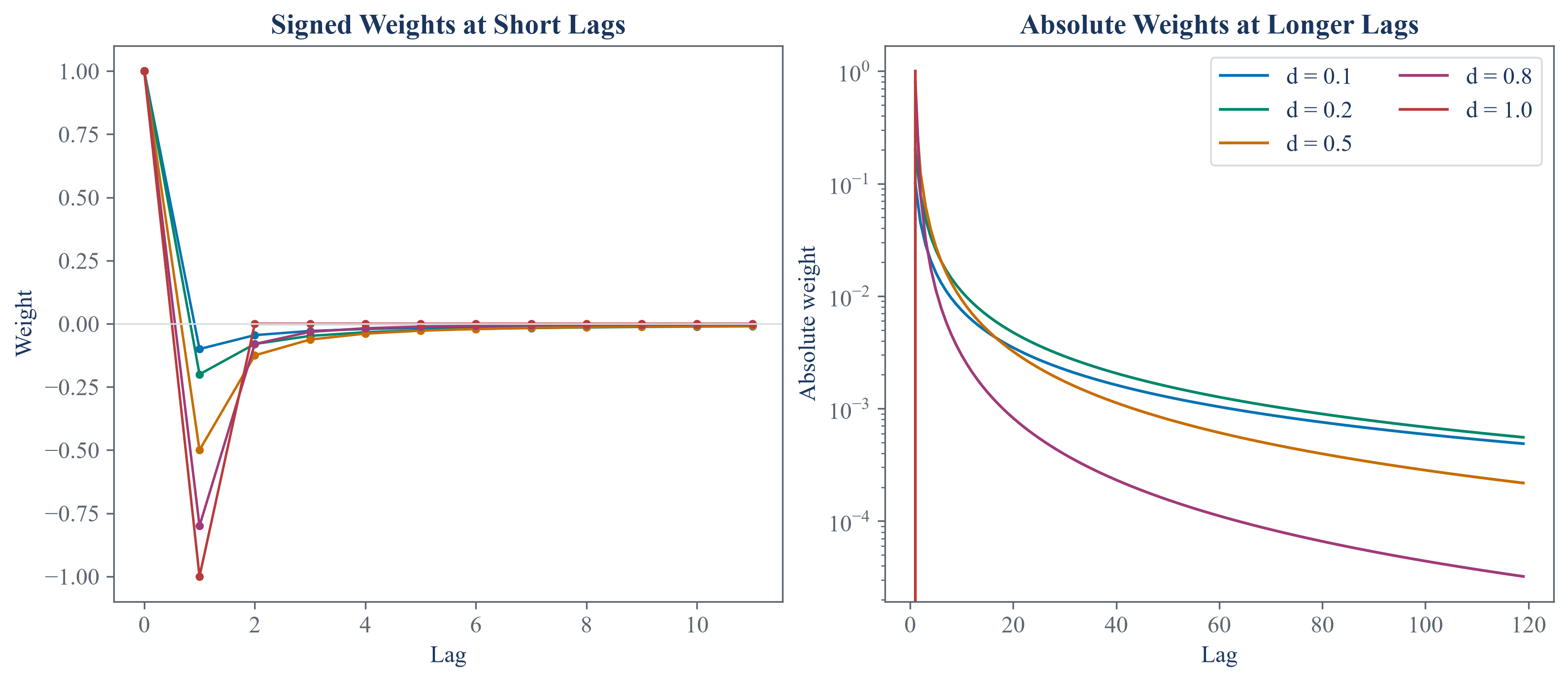
Small difference orders retain longer memory because the lag weights decay more slowly. Larger orders place less weight on distant observations.
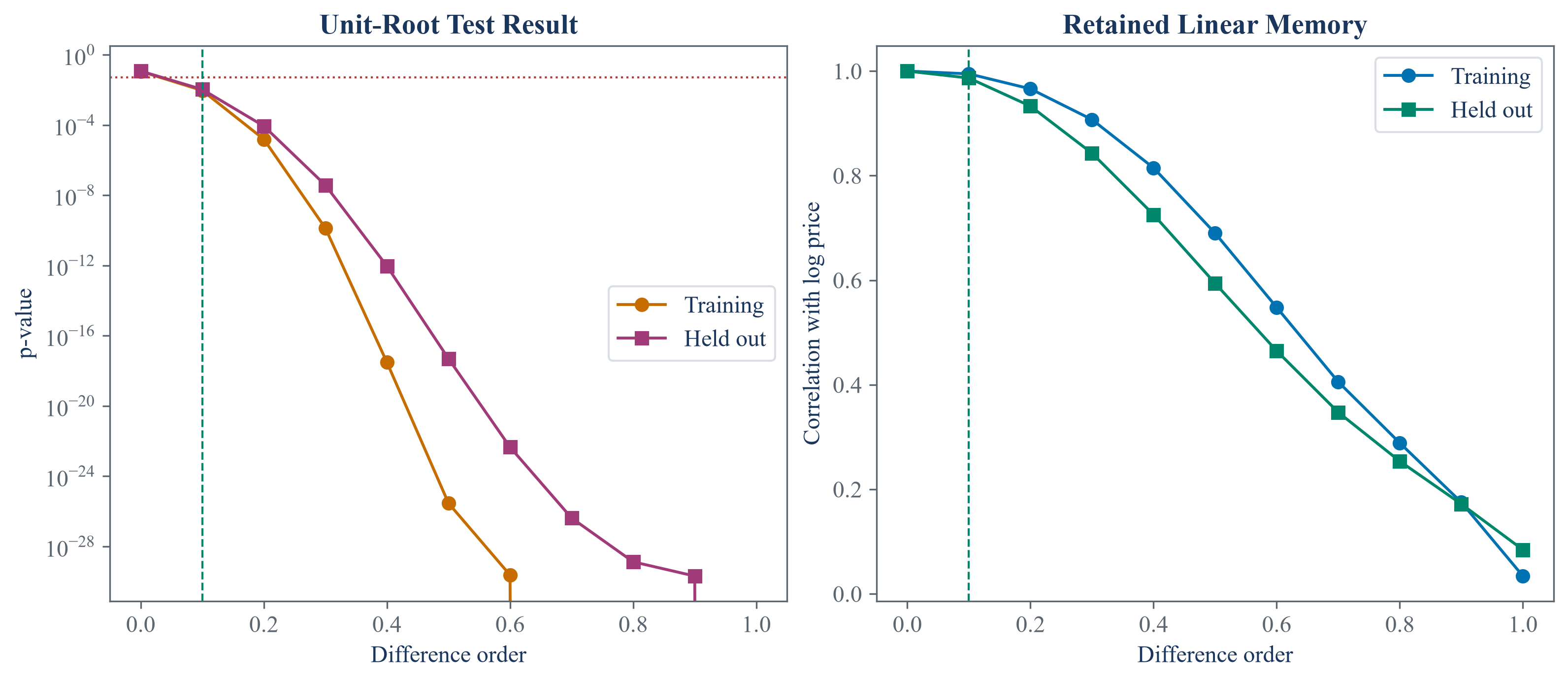
The stability plot checks the selected order on later observations instead of relying only on the period used for selection.
The order is a modeling choice. Passing one stationarity check does not guarantee stable behavior under another sample or another notion of memory.
Notebooks
| 1. Constructing fractional differences from binomial weights |
| 2. Preserving memory with a fixed-width operator |
| 3. Selecting the difference order for out-of-sample stability |