- Published on
Market Microstructure from Prices
Transaction prices contain traces of the spread and short-horizon volatility. The notebooks examine range-based estimators, compare their components, and measure their error in controlled and public examples.
The central relation
A proportional effective spread can be represented as
is the transaction price, is the unobserved fair price, and records whether the trade is buyer or seller initiated. The value measures the round-trip price concession relative to fair value.
Estimating trading costs from price ranges
The component plot shows how price ranges enter the Corwin-Schultz construction. The public comparison places EDGE beside other price-only estimates.
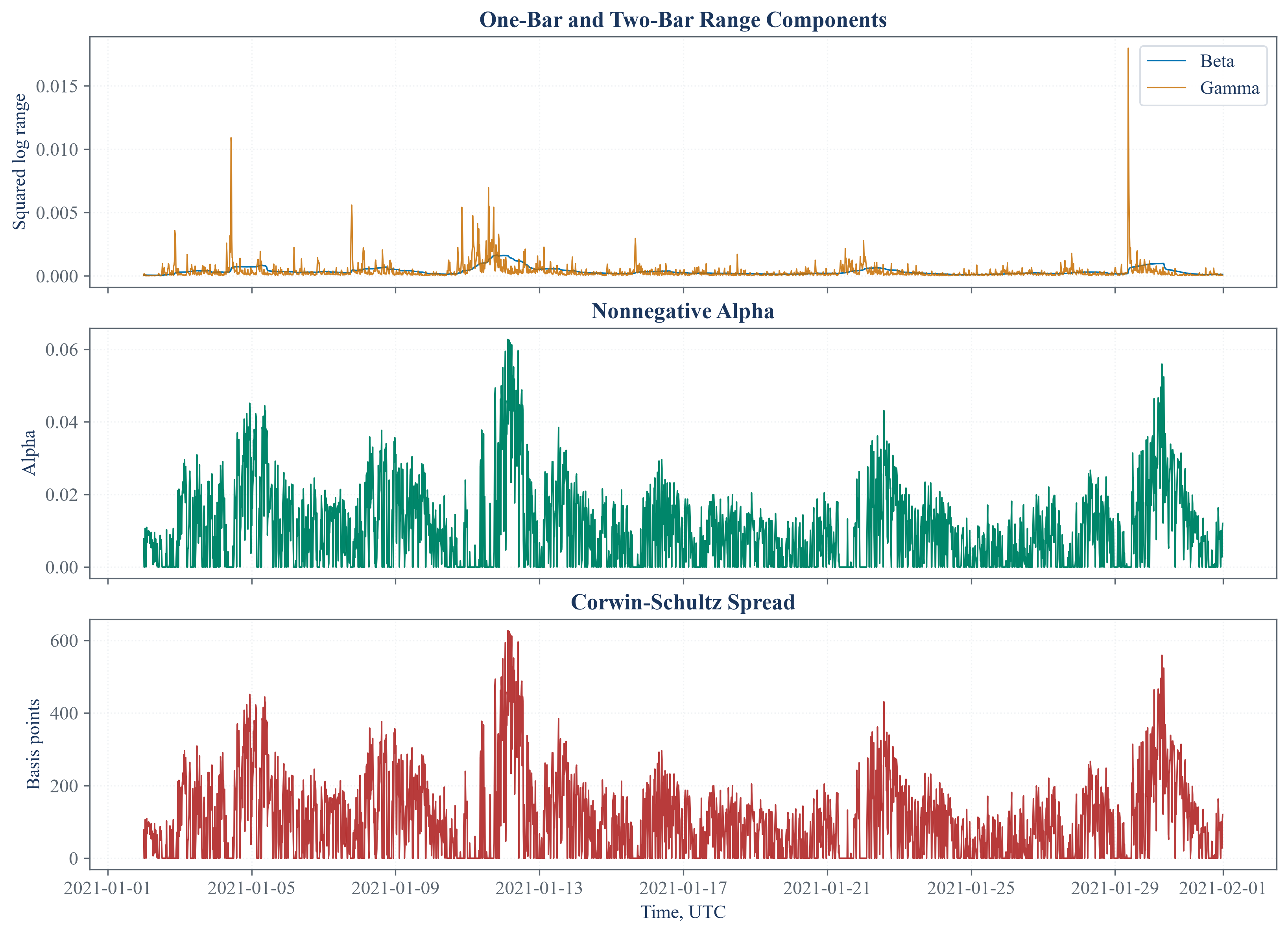
The range components combine one-day and two-day high-low movements to separate a spread signal from price variation.
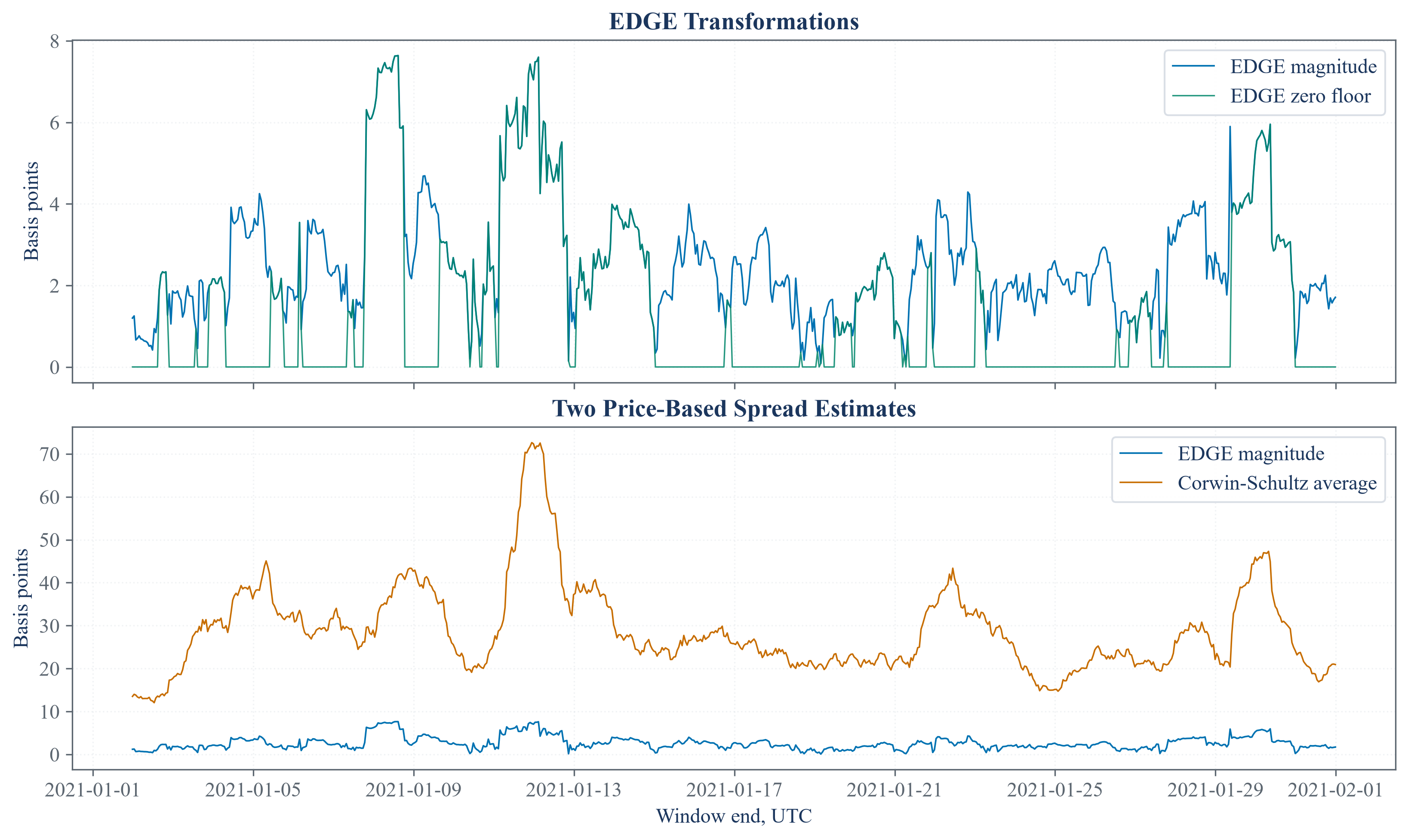
The public-data comparison shows the level and variation of several price-only spread estimates over the same periods.
These estimators infer latent trading quantities from prices. Their agreement is a diagnostic, not direct observation of the true spread.
Notebooks
| 1. Inferring liquidity from observed price ranges |
| 2. Estimating spread and volatility from price ranges |
| 3. Evaluating EDGE in finite samples |