- Published on
Proportional Clearing in Financial Networks
An institution’s payment depends on what it receives from the rest of the network. The notebooks solve this fixed-point problem and compare how ring, core-periphery, community, and concentrated liability structures transmit shocks.
The central relation
The proportional clearing vector satisfies
contains total payments, contains promised payments, and contains assets from outside the network. The matrix records relative liabilities, so is the vector of payments received from other institutions. The minimum is componentwise.
How shocks propagate through financial liabilities
The payment plot compares what institutions owe with what the clearing solution permits them to pay. The shock curves show unpaid liabilities as external assets fall.
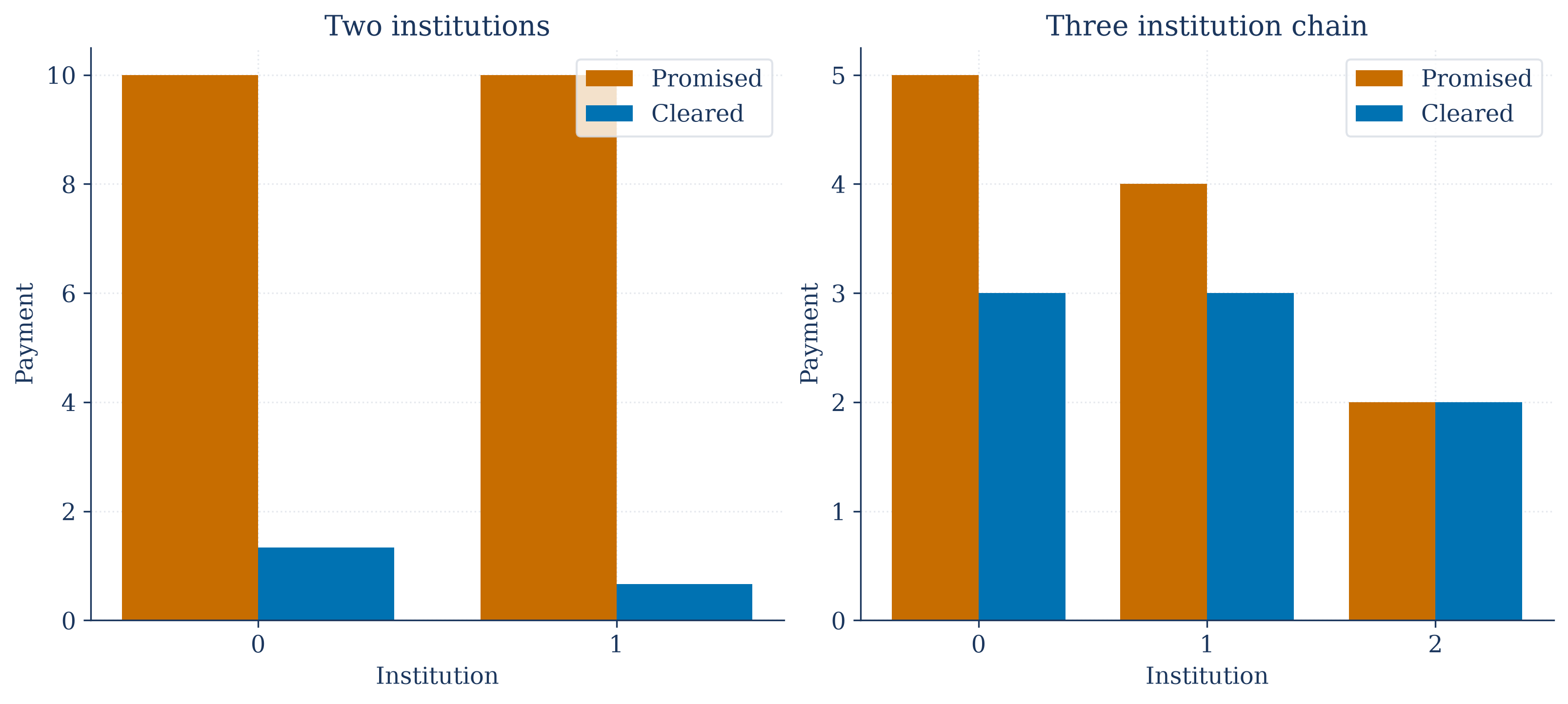
Institutions with insufficient external and incoming resources pay less than promised, and those shortfalls alter the resources of their creditors.
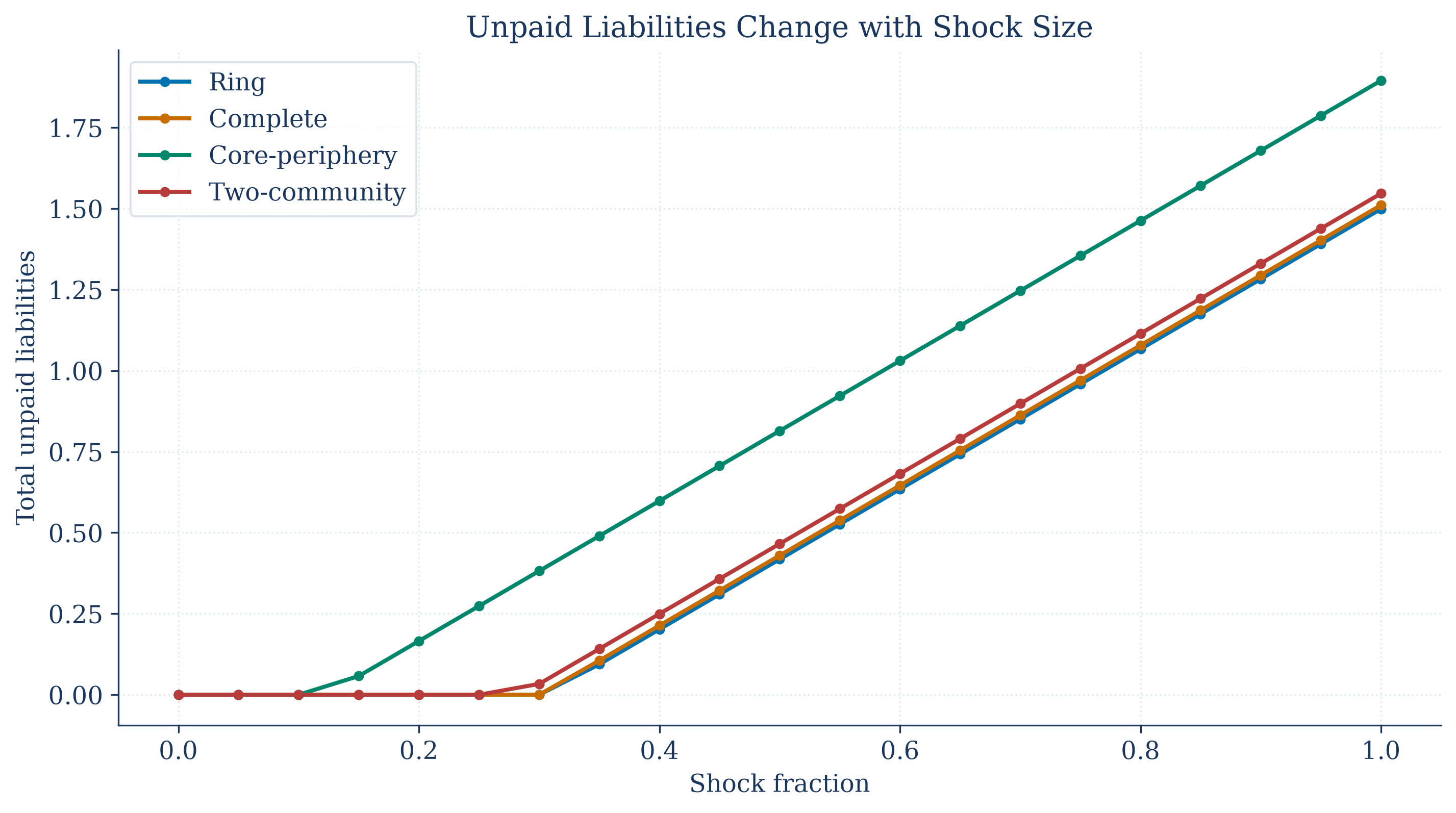
The same external shock produces different unpaid amounts under different liability structures, revealing the role of topology and concentration.
The calculation is a stylized settlement mechanism with declared liabilities and external assets. It does not estimate the probability of a real institution’s default.
Notebooks
| 1. Proportional Clearing |
| 2. How network structure changes shock loss |
| 3. How concentrated liabilities amplify systemic loss |