- Published on
Measuring Ambiguity in Probability Laws
Risk describes variation under one stated probability law. Ambiguity describes disagreement among several plausible laws. The notebooks keep those ideas separate and show how the answer changes with the supplied weights and probability grid.
The central relation
For mean bin probability and across-law variance , the finite ambiguity measure is
is the number of outcome bins and is the number of supplied laws. Law receives weight and assigns probability to bin . The value measures disagreement about that bin, while combines the bin contributions.
Separating ordinary risk from ambiguity
The controlled example distinguishes ordinary risk from ambiguity. The public-data example then compares annual risk with disagreement among fitted monthly laws.
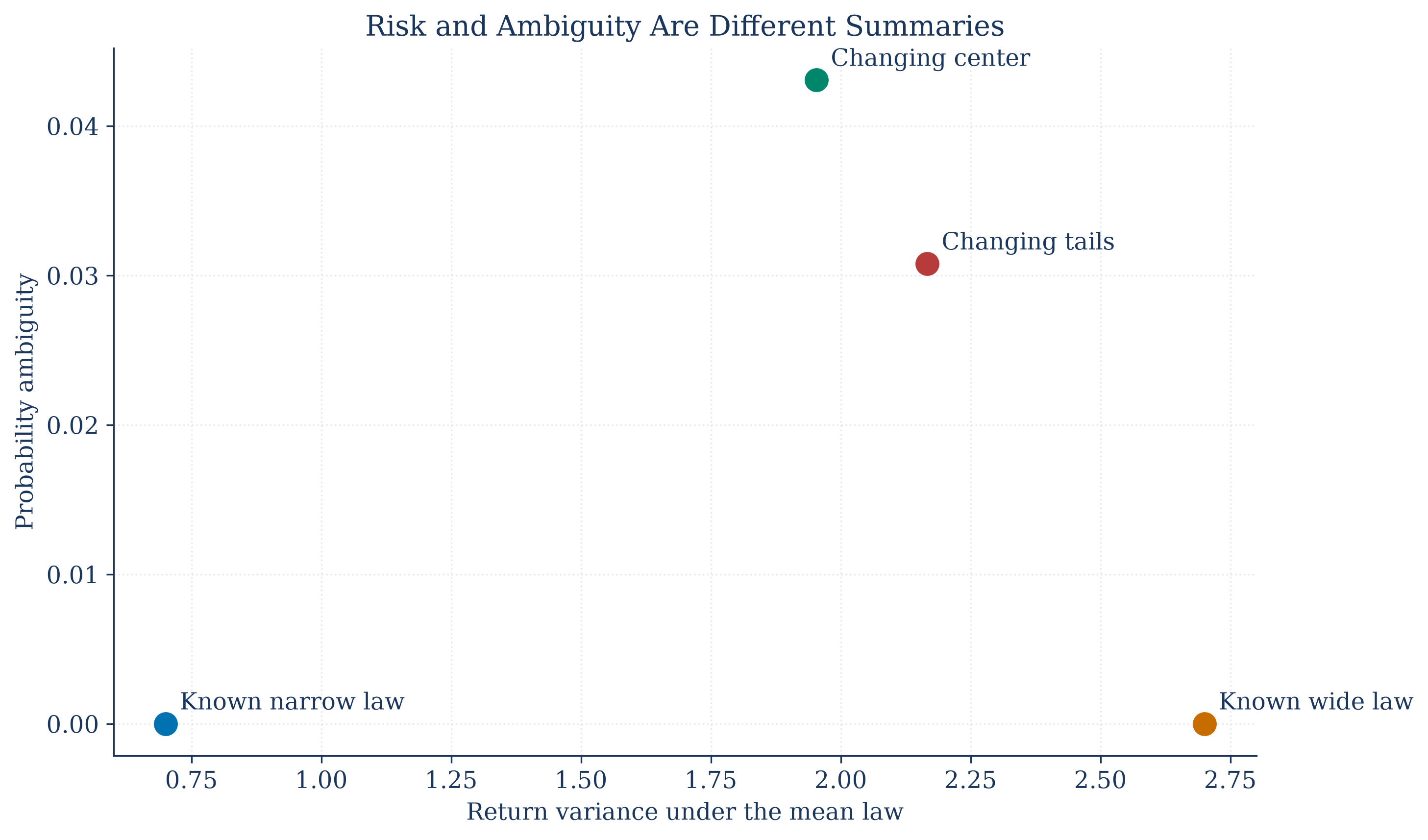
The controlled cases show that dispersion within a law and disagreement across laws can move separately.
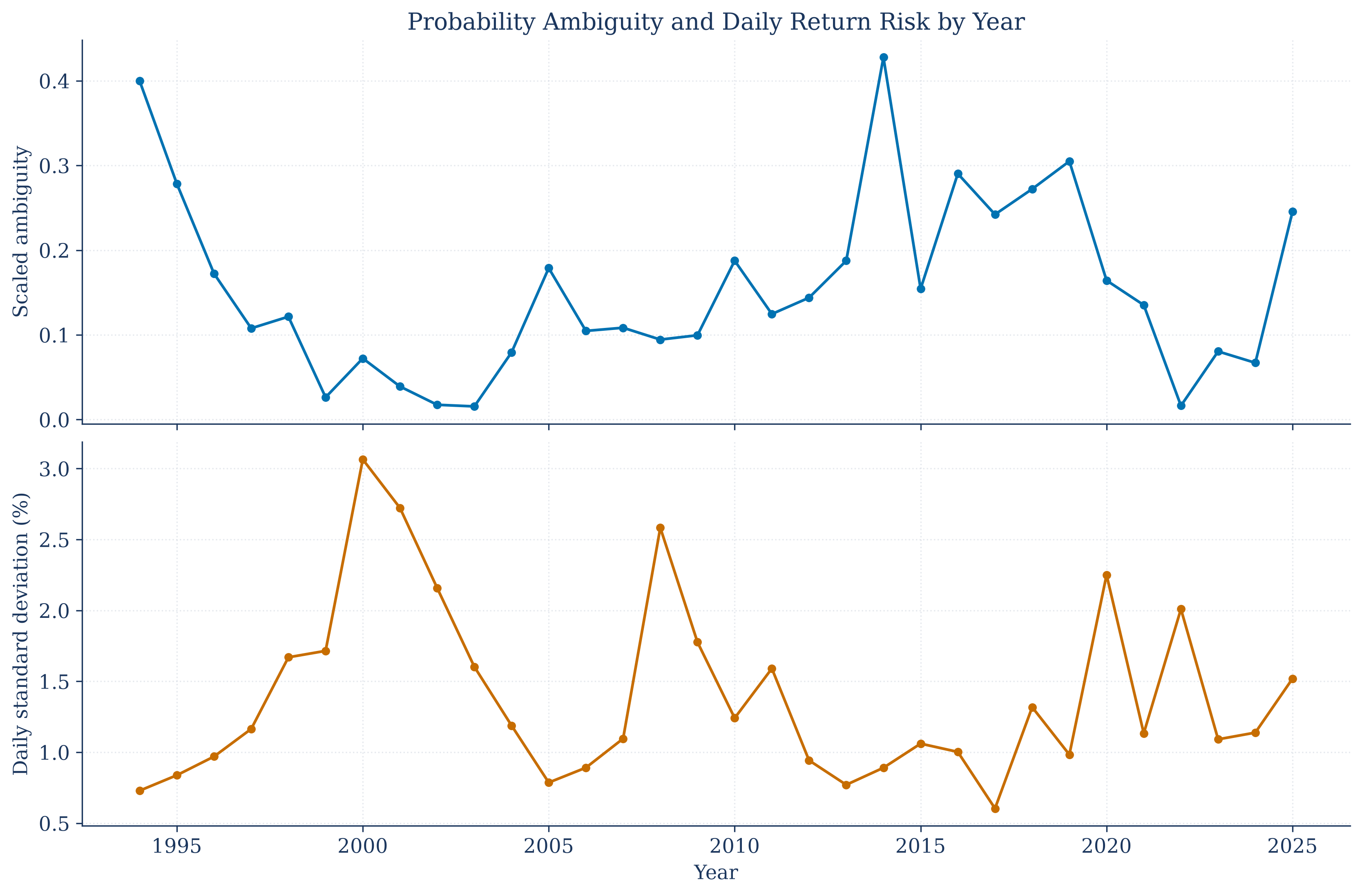
The public example compares realized return variation with disagreement among twelve fitted monthly laws. The two series answer different questions and need not move together.
The public calculation treats fitted monthly laws as a teaching construction, not as observed investor beliefs. Grid and weight checks remain part of the reported result.
Notebooks
| 1. Separating ambiguity from ordinary risk |
| 2. A Finite Calculation from Supplied Priors |
| 3. Measuring ambiguity in public market data |